

Designing Trust in AI Workflows with Human-in-the-Loop (HITL) [NEW]
- Akshay Kanbargi | Senior Product Manager
Modern workflows are increasingly powered by AI, processing large volumes of data faster than ever before. But speed doesn’t always guarantee correctness.
Imagine an AI system approving a loan, validating KYC data, or processing an insurance claim only to realize later that a critical detail was incorrect. In a loan approval workflow, a 2-minute human review is a small price for catching a data error that costs thousands. In a KYC check, missing a fraudulent document could mean regulatory penalties far greater than any efficiency gain.
In high-stakes scenarios like these, blind trust in automation isn’t just risky, it’s unacceptable.
This is where Human-in-the-Loop (HITL) becomes essential.
What is Human-in-the-Loop (HITL)?
Human-in-the-Loop (HITL) is a design pattern that introduces human judgment into automated workflows.
Instead of letting workflows run end-to-end autonomously, HITL creates a controlled pause, allowing a human to:
- Review outputs
- Validate decisions
- Correct data if needed
Only after this intervention does the workflow proceed.
Think of it as a governance checkpoint, where automation meets accountability.
Why HITL Matters
AI is powerful, but it operates on probabilities not certainty.
HITL helps:
- Ensure data accuracy in critical workflows
- Reduce business risk from incorrect automation
- Bridge the gap between raw AI output and business-ready decisions
It’s especially valuable when:
- Data is ambiguous
- Decisions are high-value
- Regulatory or compliance checks are required
How HITL Works in a Workflow
At a high level, HITL introduces a simple but powerful lifecycle:
- The workflow reaches a review point
- Execution pauses
- Data is sent to a human reviewer (via webhook or external system)
- The human validates or corrects the data
- A decision is submitted
- The workflow resumes based on that decision

Decision-Driven Workflow Control
A key aspect of HITL is that it doesn’t just pause workflows, it actively controls how they proceed.
Every review results in a decision:
- Approved → Workflow continues forward
- Rejected → Workflow diverts or stops
But beyond binary decisions, HITL also enables something more powerful:
Humans can modify the data itself
This means downstream systems don’t just get a decision, they receive:
- Validated data
- Corrected inputs
- Enriched context
Designing HITL into Workflows
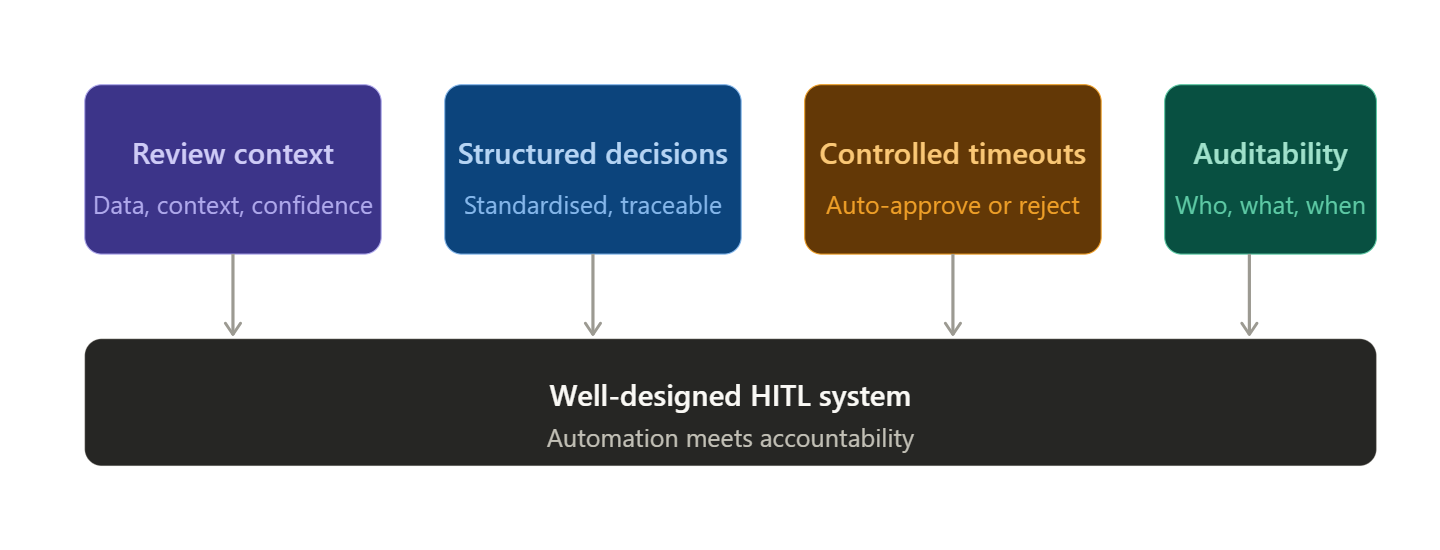
A well-designed HITL system typically includes four pillars:
1. Clear Review Context
The human reviewer must have:
- The relevant data
- Supporting context
- Enough information to make a confident decision
2. Structured Decisioning
Decisions should be:
- Standardized (e.g., Approved / Rejected)
- Traceable
- Easy to audit
3. Controlled Timeouts
Human intervention cannot block workflows indefinitely.
Timeout strategies help maintain system reliability:
- Auto-approve (trust automation)
- Auto-reject (fail safe)
- Fail workflow (strict control)
4. Auditability & Traceability
Every HITL step should be traceable:
- Who reviewed the data
- What decision was made
- What changes were applied
This is critical for compliance-heavy industries.
Handling Real-World Data (Including Files)
In many workflows, humans don’t just review text - they review documents, images, or files.
A scalable HITL design:
- Sends file references, not raw files
- Allows secure retrieval when needed
- Maintains performance and security
The Role of Webhooks in HITL
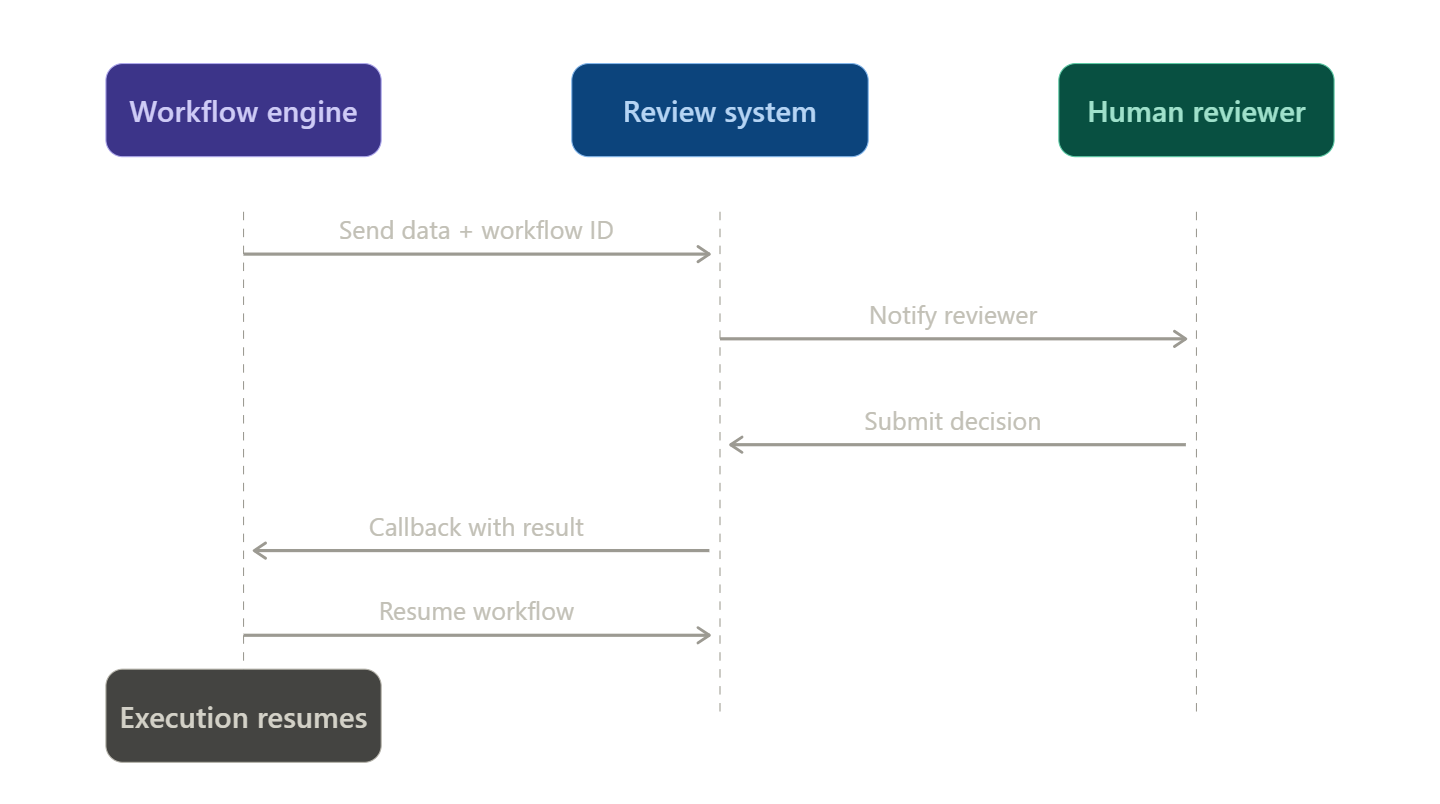
HITL systems typically rely on webhooks to communicate with external review systems.
- The workflow sends data out for review
- A callback mechanism is used to resume execution
- Each request is tracked using unique identifiers (workflow ID, trace ID)
This ensures:
- Decoupled architecture
- Scalability
- Secure, asynchronous processing
Where HITL Delivers the Most Value
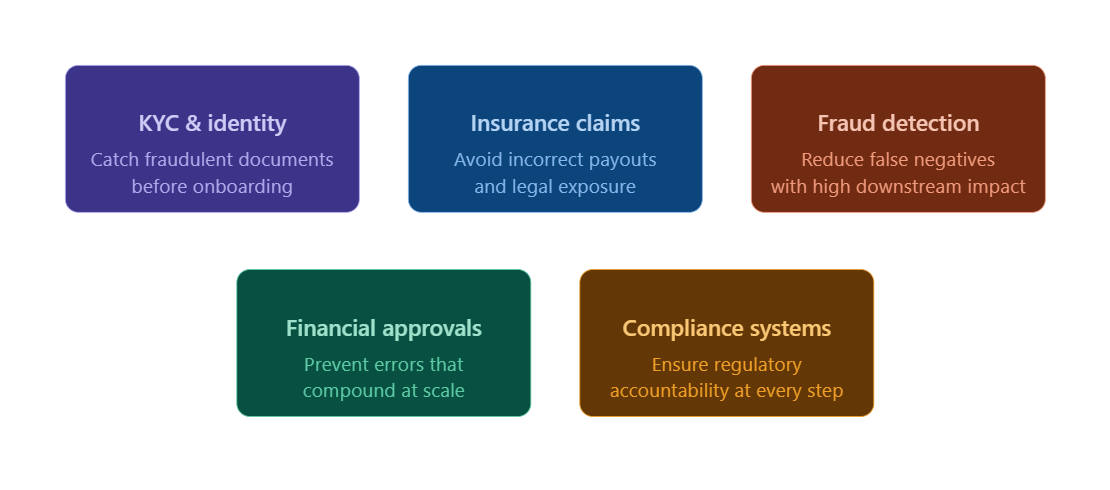
HITL is not needed everywhere, but as we saw with loan approvals, KYC checks, and insurance claims at the start of this post, the cost of being wrong is far greater than the cost of slowing down. It is critical in:
The Trade-Off: Speed vs Trust
Adding humans into workflows introduces latency
But it also introduces:
- Confidence
- Accuracy
- Accountability
The goal isn’t to slow everything down, it’s to insert human judgment only where it matters most.
Real-World Use Case: AI-Assisted Invoice Processing
To see HITL in action, consider how a Finance and IT team handles daily invoice processing.
Every day, invoices are uploaded to a Google Drive folder. Instead of someone manually opening each file, copying out vendor names, amounts, and dates, and routing them for approval, the entire process is automated - with one deliberate human checkpoint built in.
An AI agent reads each invoice and extracts the key data. That data is paused and handed to a human reviewer, who cross-references it against the original file and marks each invoice as approved or rejected. Once the review is complete, the workflow resumes automatically: approved and rejected invoices are sorted, and a second AI agent drafts a clean summary email sent to the whole team.
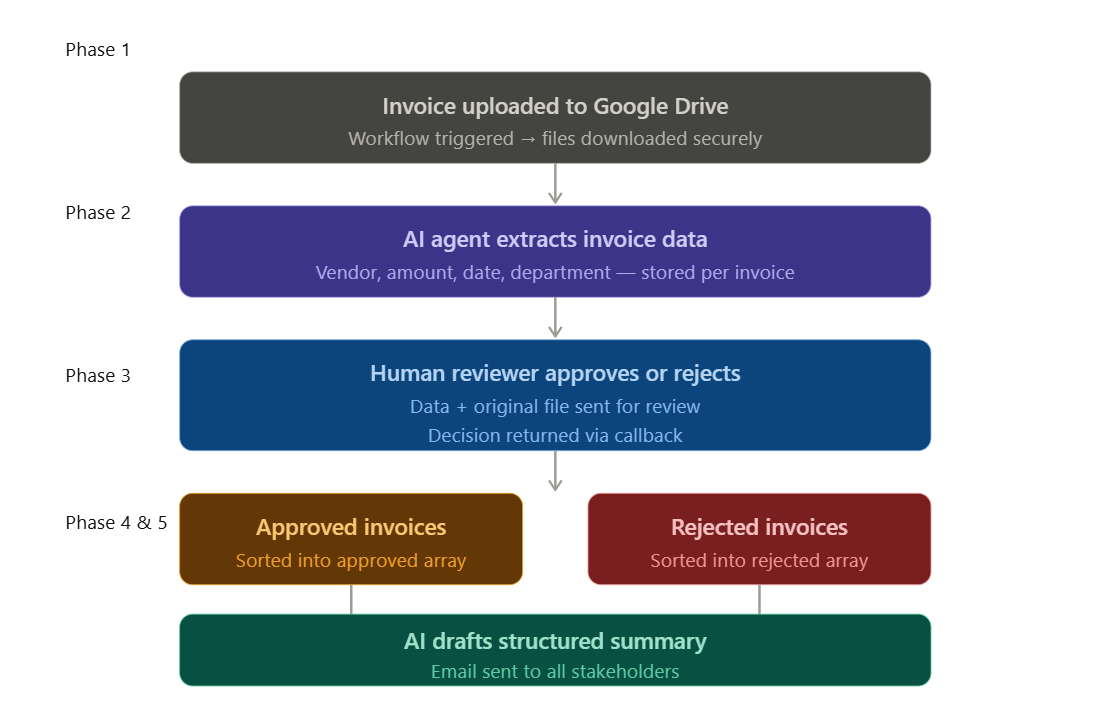
The result is a workflow that eliminates manual data entry, prevents AI errors from causing financial mistakes, and gives every stakeholder a daily, auditable record without slowing the process down.
This is exactly what HITL is designed for: AI handles the volume, humans handle the judgment, and the system handles the rest.
Final Thought
The future of workflows isn’t fully automated, it’s intelligently augmented.
Human-in-the-Loop ensures that as systems scale, trust scales with them.
Because in the end, the most reliable systems aren’t the ones that avoid humans, they’re the ones that know exactly when to involve them.