

From Static Sheets to Intelligent Execution [NEW]
Reimagining Spreadsheet Work with Purple Fabric
- Vishvanath Sriram | Senior Product Manager
Enterprise AI has made remarkable progress in reasoning, retrieval, and automation.
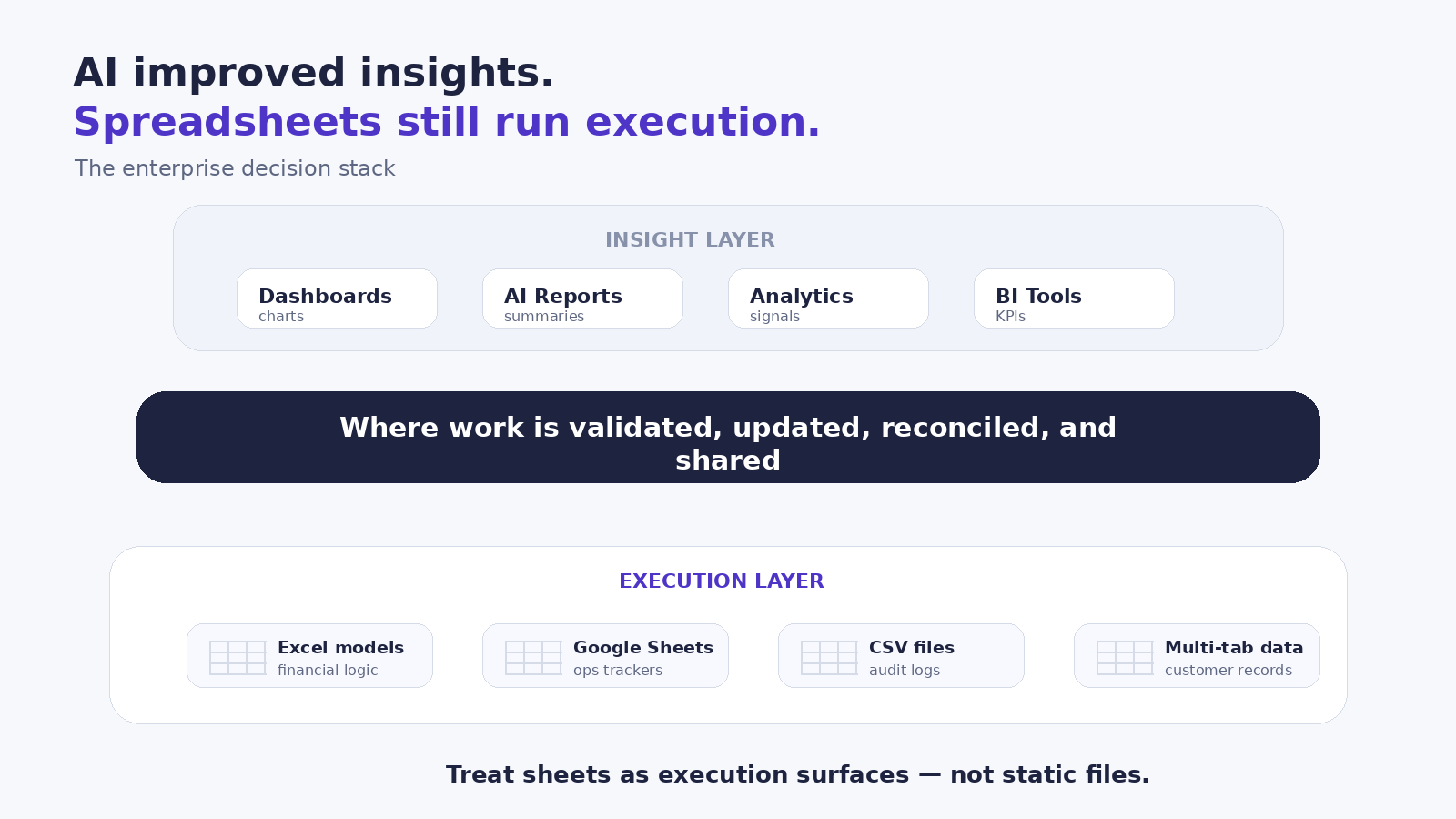
But one layer of enterprise work has remained largely untouched:
Not because they are simple.
But because they are too critical to get wrong. ”
The Reality: Enterprises Don’t Run on Dashboards. They Run on Sheets.
Behind every AI initiative, you’ll still find:
- Financial models maintained in Excel
- Operational trackers in Google Sheets
- Audit logs and reconciliations in CSVs
- Customer data stitched together across tabs
Spreadsheets are where decisions are finalized, validated, and shared.
And yet, most AI systems treat them as:
- static files to upload
- raw data to parse
- or outputs to export
Never as active systems of execution. That’s where things break.
The Problem: AI Can Read Sheets. It Cannot Work Like Them.
Traditional AI interactions with spreadsheets fall into three buckets:
-
Read-only intelligence
→ “Summarize this sheet”
→ “Find anomalies” -
One-time transformations
→ “Convert to CSV”
→ “Generate report” -
Disconnected automation
→ Export → Process → Re-import
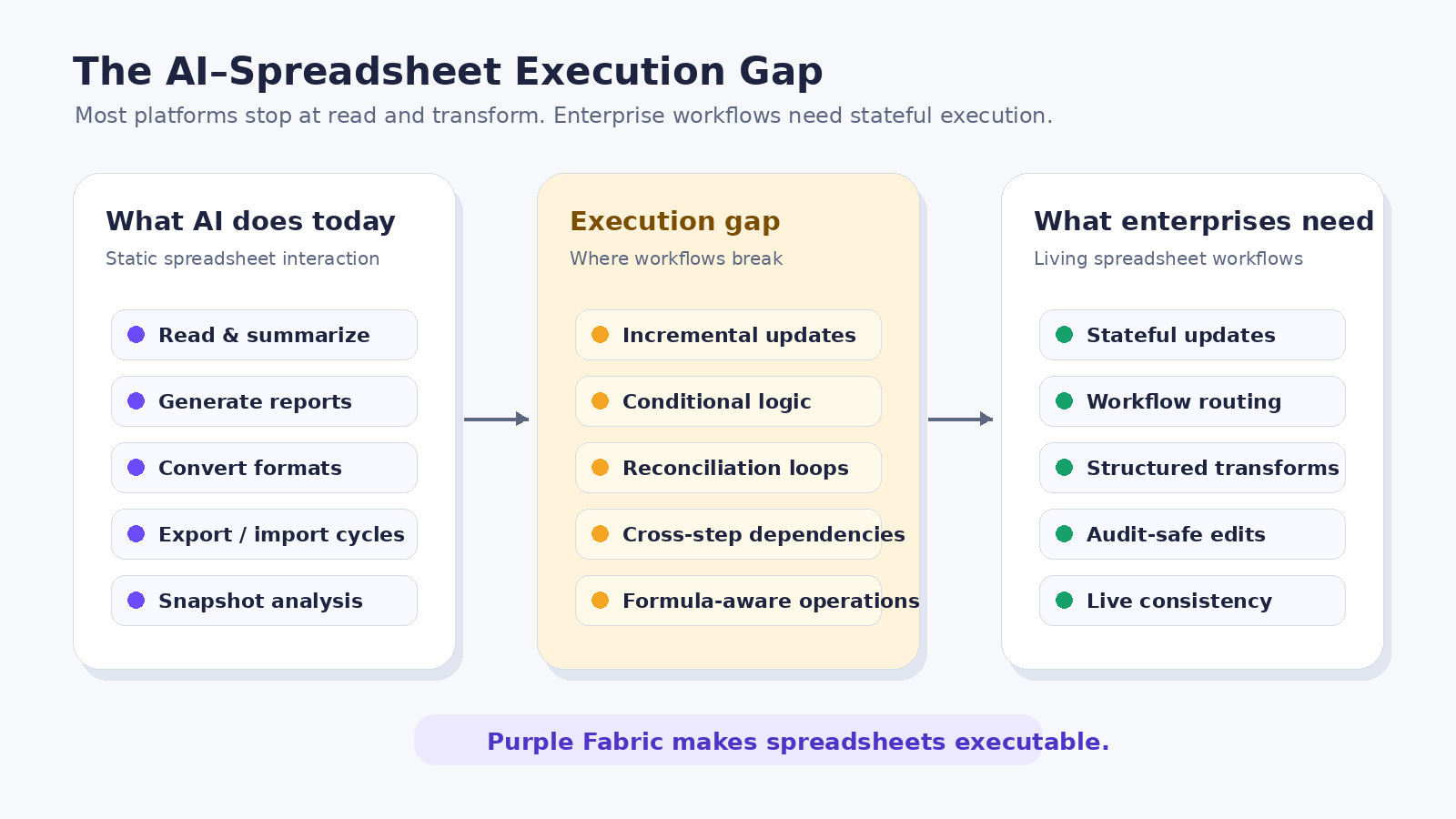
This creates a fundamental gap:
AI can analyze spreadsheet data...
But it cannot operate within spreadsheet workflows.
- incremental updates
- conditional logic
- structured transformations
- reconciliation loops
- multi-step dependencies
Spreadsheets are not just data. They are living systems.
The Shift: From Spreadsheet as File → Spreadsheet as Execution Layer
Purple Fabric takes a fundamentally different approach. Instead of treating spreadsheets as inputs or outputs, PF turns them into:
An active, controllable, and programmable execution layer inside AI systems
This capability is now deeply embedded across the platform:
- Prime Template (AI Agents & Teams of Agents)
- Automation Agents (I/O driven execution)
- Conversational Agents (context-aware interactions)
- Flow Designer (workflow nodes with spreadsheet actions)
Spreadsheets are no longer external artifacts.
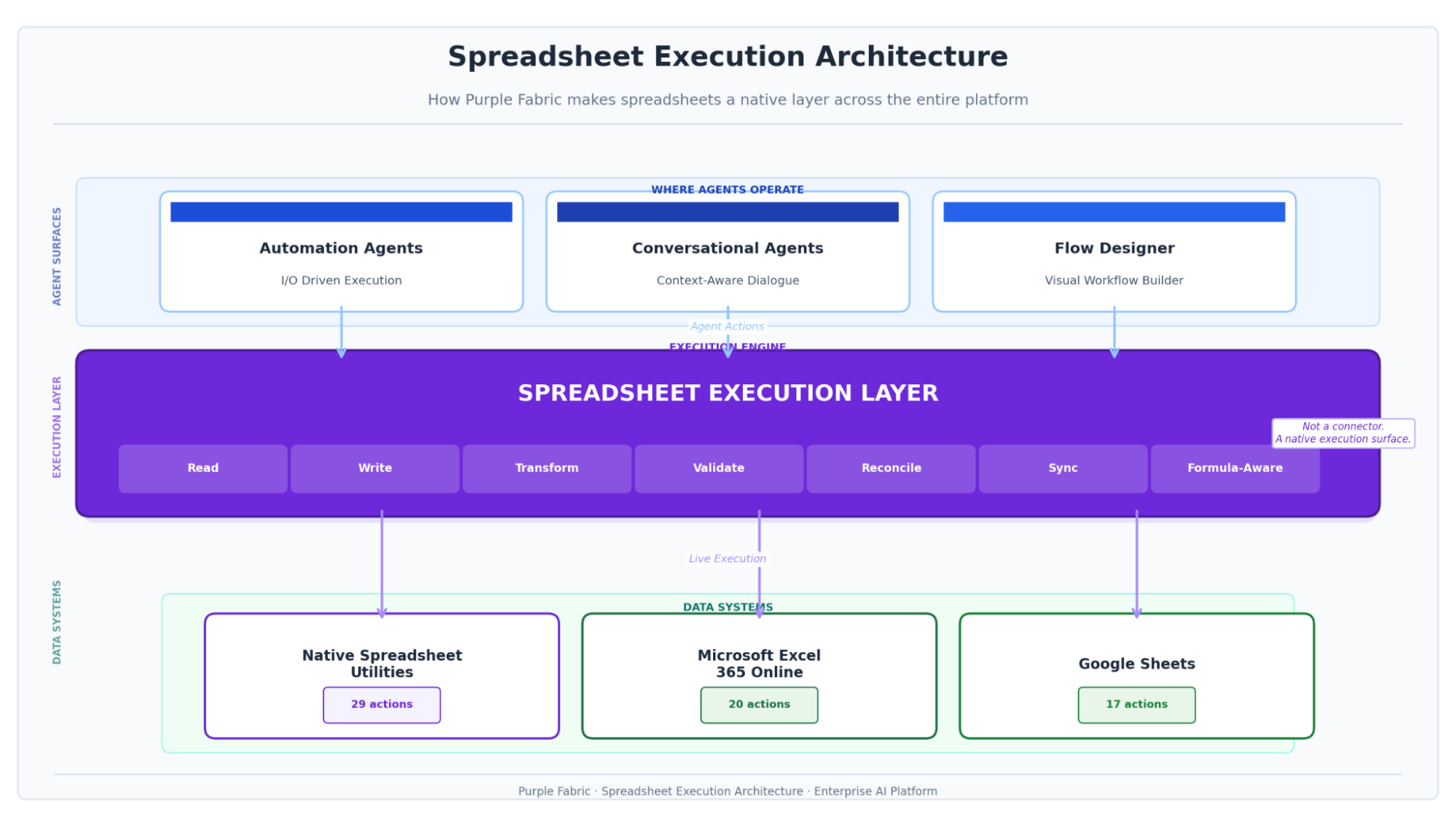
They are native to how agents think, act, and deliver.
What This Actually Means
Purple Fabric doesn’t just “integrate with Excel or Sheets.” It gives agents the ability to operate like a spreadsheet user - but at machine precision and scale.
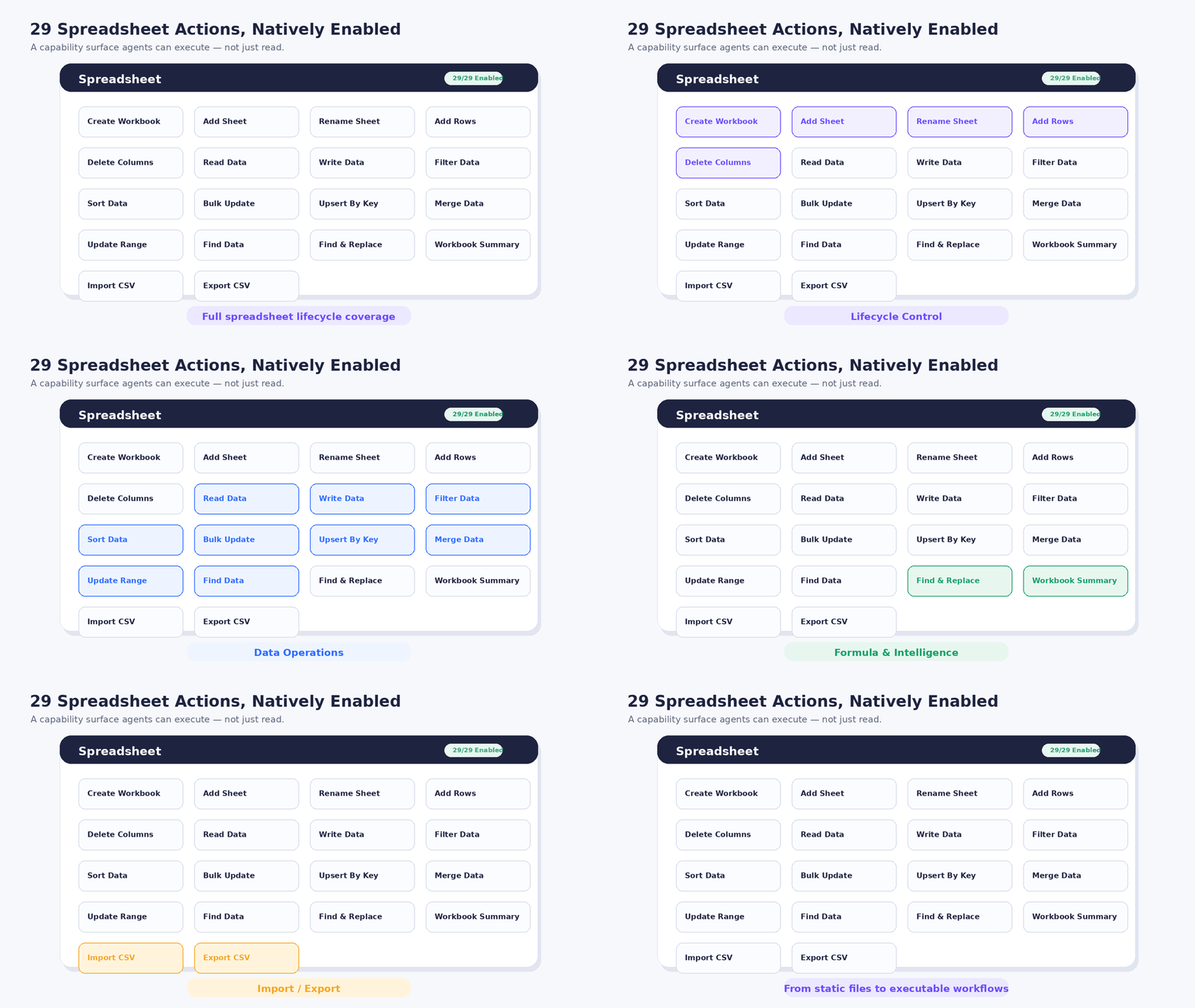
1. Full Lifecycle Control (Not Just Read/Write)
Agents can:
- create workbooks and sheets
- insert, update, delete rows and columns
- manage ranges and structures
- rename, reorganize, and clean data
This turns spreadsheets into stateful systems, not static files.
2. Structured Data Operations (Beyond Basic Edits)
Agents can:
- filter and query data
- perform bulk updates based on conditions
- upsert records intelligently
- sort, merge, and transform datasets
This enables database-like operations within spreadsheets, without moving data out.
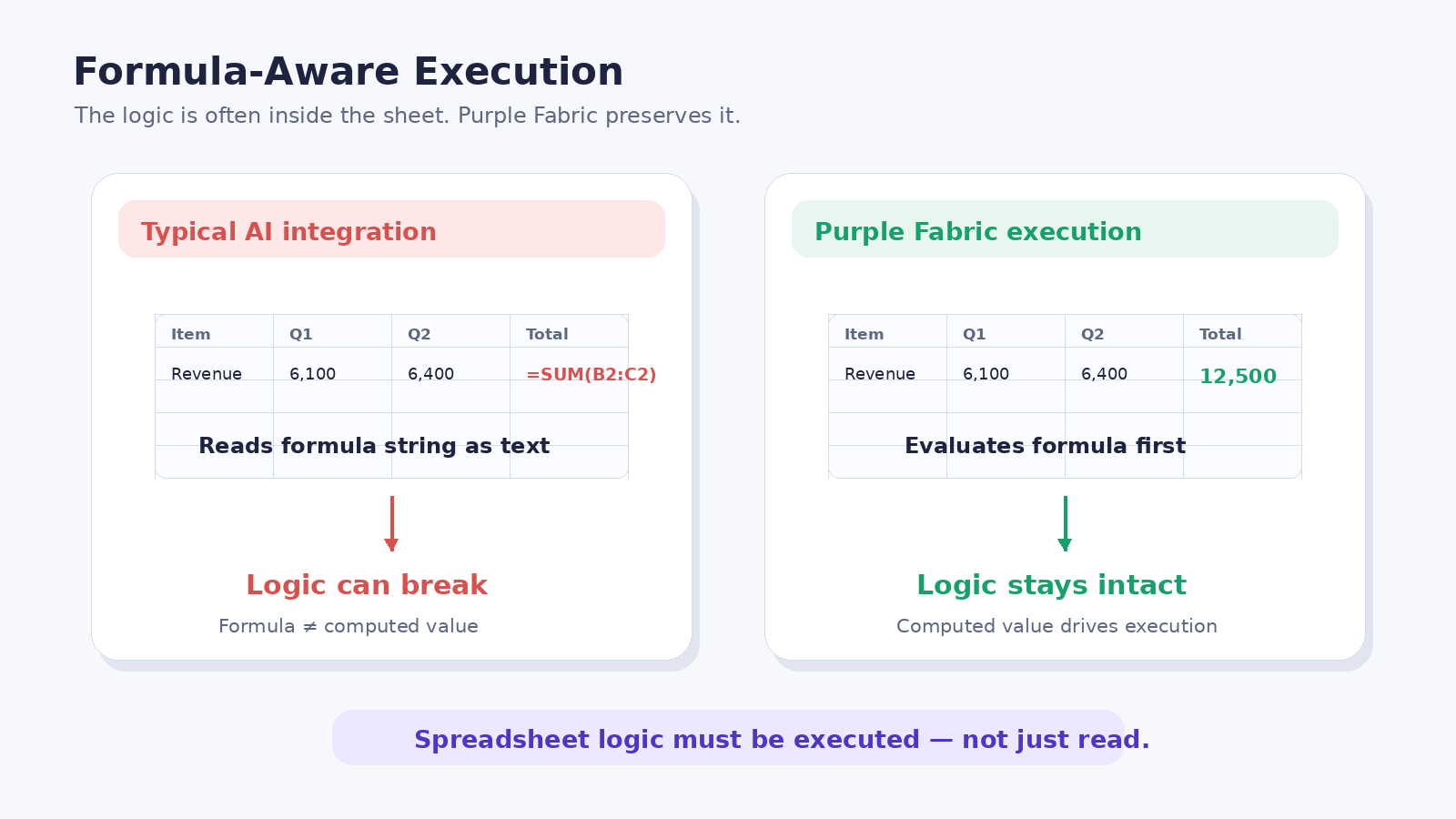
3. Formula-Aware Intelligence
Unlike typical integrations, Purple Fabric:
- evaluates formulas before processing
- works with computed values, not raw expressions
- preserves spreadsheet logic integrity
This is critical because in enterprise workflows, the logic is often inside the sheet, not outside it.
4. Multi-System Interoperability
Across:
- Native Spreadsheet utilities
- Excel 365 Online
- Google Sheets
Agents can:
- read, write, sync, and update across systems
- orchestrate cross-platform data flows
- maintain consistency without manual intervention
This eliminates one of the biggest enterprise problems:
fragmented spreadsheet ecosystems.
5. Spreadsheet Actions as First-Class Workflow Nodes
In Flow Designer, Spreadsheets are not side-effects. They are explicit steps in execution pipelines:
- ingest → transform → validate → update → export
- condition-based routing using sheet data
- multi-step reconciliation loops
This enables deterministic + agentic workflows working together.
Where This Becomes a Breakthrough
Once spreadsheets become executable, entire enterprise workflows change.
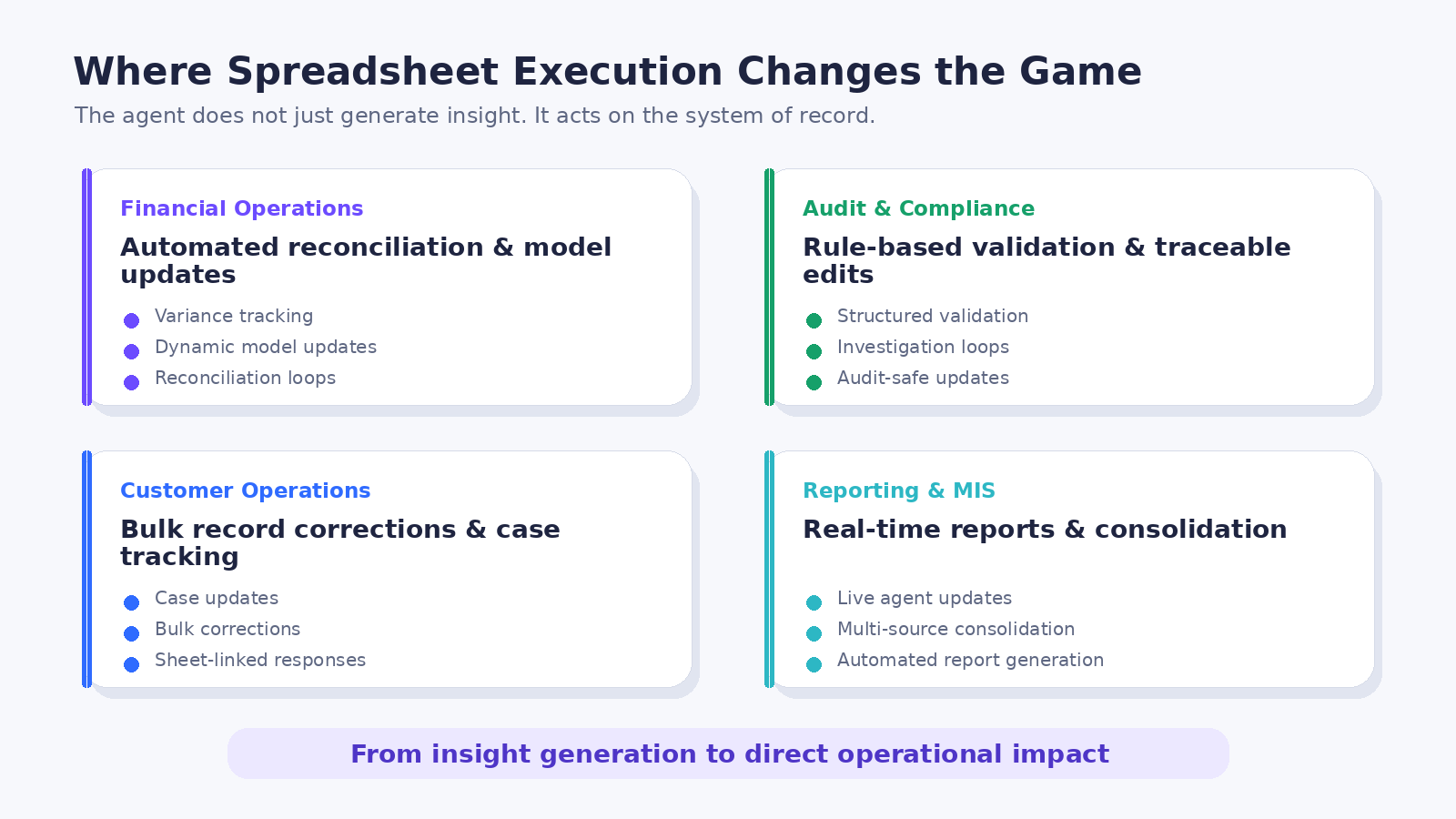
Financial Operations
- automated reconciliations
- dynamic financial model updates
- variance tracking and correction
Audit & Compliance
- rule-based validations
- structured investigation loops
- traceable updates to audit sheets
Customer Operations
- case tracking updates
- bulk record corrections
- structured response generation tied to sheet data
Reporting & MIS
- real-time sheet updates from agent outputs
- multi-source data consolidation
- automated report generation
In all these cases:
The agent doesn’t just generate insights
It acts directly on the system of record
Why This Matters for Enterprise AI
Most AI platforms focus on:
- better models
- better prompts
- better retrieval
But enterprise execution fails at a different layer:
The last mile - where outputs must become structured, usable, and actionable.
Spreadsheets are that last mile.
Without controlling them:
- outputs remain disconnected
- workflows remain manual
- accuracy breaks at execution
Purple Fabric closes this gap.
The Bigger Picture: Execution Engineering
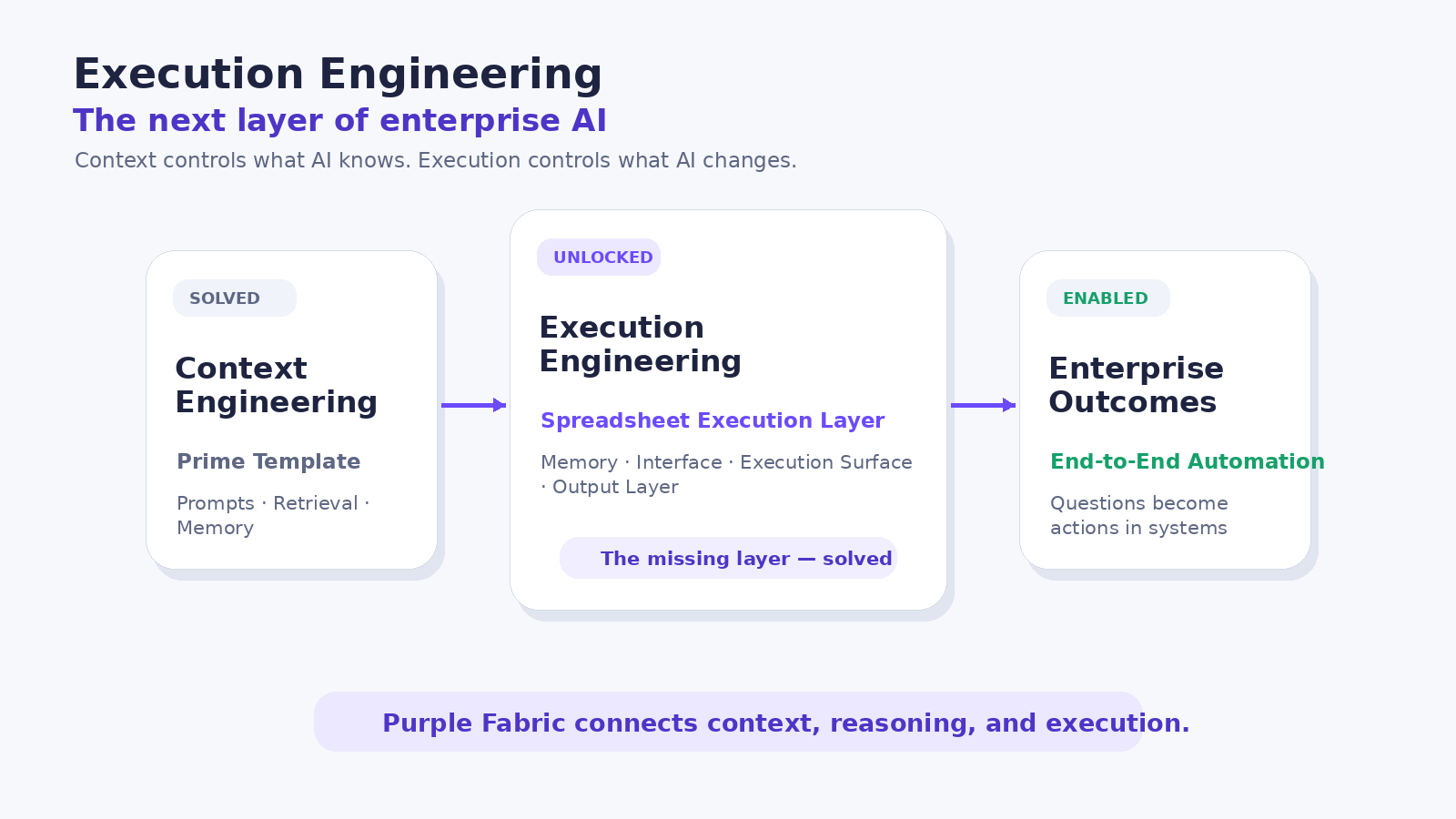
If Prime Template solved Context Engineering, Spreadsheet capabilities unlock the next layer:
Execution Engineering
Where:
- context is controlled
- reasoning is structured
- and execution happens directly in enterprise systems
From Insight to Action - Without Leaving the System
This is the real shift Purple Fabric enables:
- Not just answering questions
- Not just generating reports
- Not just analyzing data
Operating enterprise workflows end-to-end - inside the same system
With spreadsheets acting as:
- memory
- interface
- execution surface
- and output layer
Final Thought
- For years, spreadsheets have been the backbone of enterprise operations.
- AI tried to replace them.
- Most systems tried to work around them.
- Purple Fabric does something different.
- It brings them into the core of AI execution.